

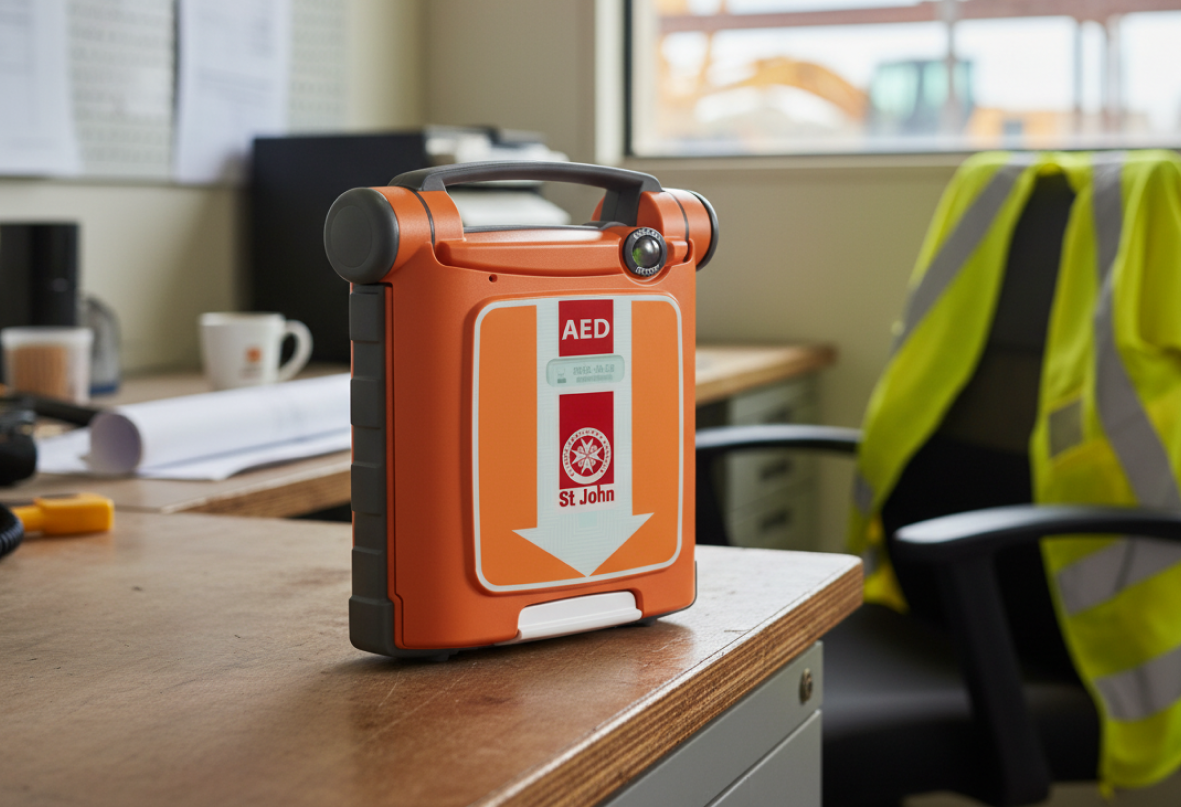
The short answer: probably yes. The longer answer depends on your workplace, your people, and how quickly help can reach you in an emergency. This guide walks you through a quick self-check, what the law says in WA, and how to raise it internally if you're the one who has to make the case.
Start here: the 60-second check
f any of these sound like your workplace, a defibrillator is worth serious consideration:
- Physically demanding work. Construction, mining, warehouses, manufacturing. Physical exertion and heat stress raise cardiac risk.
- More than 10 minutes from an ambulance. If you're regional or remote, you're relying on whatever first aid resources are already on site.
- A large workforce. The more people in your building, the higher the statistical chance someone will need one.
- Public-facing venues. Gyms, pools, sporting clubs, schools, community centres. You're looking after visitors and members, not just staff.
- An older workforce. Cardiac risk climbs with age. If a good portion of your team is over 40, the risk profile shifts.
- High-stress environments. Stress is a known cardiac risk factor, from call centres to emergency services to high-pressure offices.
Ticked one or more? You're probably right to be thinking about it. Read on for the why, and for how to make it happen.
Why access to a defibrillator matters
More than 33,000 Australians experience sudden cardiac arrest each year. It can happen to anyone, at any age, including people with no known heart conditions.
Here's the part worth knowing: a defibrillator in the hands of a bystander within the first few minutes can more than double the chance of survival. For every minute without defibrillation, the chance of a good outcome drops. No matter how fast an ambulance arrives, those first few minutes belong to whoever is already on site.
Having an AED on site closes that gap. It means someone can start treatment straight away, before the ambulance arrives.
What the law says
In most Australian states, there's no legal requirement for private workplaces to have a defibrillator. South Australia is the exception. Its Automated External Defibrillators (Public Access) Act now applies to non-government buildings, including privately owned commercial buildings with publicly accessible floor space over 600 square metres, with an additional AED required for every 1,200 square metres. Government buildings came into scope a year earlier.
Other states are watching closely. In WA, the Work Health and Safety regulations place a duty of care on employers to provide a safe workplace. That doesn't specifically mandate a defibrillator, but it does mean you're expected to assess risks and have appropriate first aid resources on hand.
Safe Work Australia's First Aid in the Workplace Code of Practice recommends considering a defibrillator based on the nature of your work and the distance from emergency medical services.
How to make the case internally
If you're the person who'd have to raise this with a manager or business owner, here's the short version that tends to land:
- It's a duty-of-care fit. WA's Work Health and Safety regulations expect employers to assess risk and provide appropriate first aid resources. An AED is a reasonable, defensible part of that.
- It's more affordable than people assume. The cost is less than most office printers, and as a business purchase it's tax-deductible.
- It's low-maintenance. Modern AEDs, including the G5, self-test automatically. You just need someone to do a quick visual check now and then and keep an eye on pad and battery expiry dates.
- Anyone can use it. AEDs are designed to be used without training. They talk the user through each step. That removes the "but no one here is qualified" objection.
If it helps, frame it the way most businesses that buy one do: not because they have to, but because they want their people looked after if something unexpected happens.
What having a defibrillator actually involves
Getting one set up is straightforward. Here's what ongoing management looks like:
- Placement. Accessible within 2 to 3 minutes of any point in your building, ideally somewhere visible and central.
- Signage. Standard AED signage so people can find it quickly when it matters.
- Checks. Most modern AEDs self-test automatically. Nominate someone to do a quick visual check periodically and watch the pad and battery expiry dates.
- Training. AEDs are designed to be used by anyone, even untrained. That said, having staff who've done a first aid course builds confidence and helps everyone feel prepared.
St John WA runs first aid training courses across WA that include AED use, so your team can walk away genuinely confident they'd know what to do.
It comes down to being prepared
Most workplaces that invest in a defibrillator don't do it because they have to. They do it because they want their people looked after if something unexpected happens. It's a practical step that gives everyone on site, staff, visitors and customers, the best chance in a cardiac emergency.
Not sure where you stand? Get a free assessment
If you'd rather have an expert look at the whole picture before deciding, St John Safe is a complimentary on-site assessment. One of our first aid specialists walks through your workplace, looks at your high-traffic areas, equipment and signage, and gives you a tailored report on what you actually need to be first aid ready. No obligation, and no guesswork.
It's free for businesses, schools and sporting clubs across the Perth metro area, and available in select regional locations too. Workplaces that meet the standard can be recognised as St John Safe.


