

First Aid Guides
Types of jellyfish
First aid for jellyfish stings can depend on what species
Jellyfish stings are common and can be painful. If you are stung, in most cases, you do not need to go to the hospital or seek further medical advice.
However, some jellyfish stings are dangerous and can cause a severe reaction, requiring emergency first aid.
If you are stung in tropical waters off the coast of WA, treat this as an emergency and call Triple Zero (000).
For bluebottle or minor non-tropical jellyfish stings, seek advice from a doctor if the pain continues.
Tropical jellyfish
Found in the tropical coastal waters of northern Australia, from Gladstone in Queensland to Geraldton in Western Australia.
Box jellyfish (Chironex fleckeri)
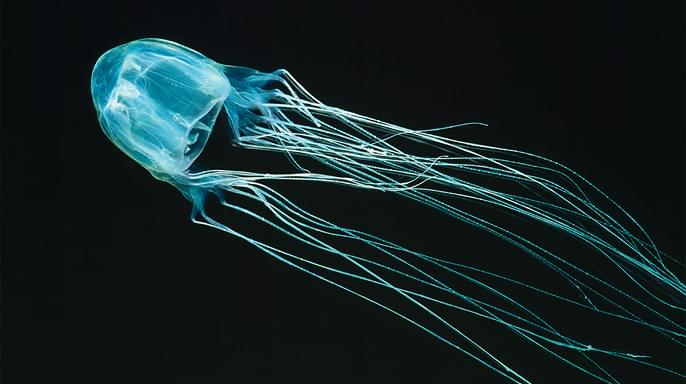
The Box jellyfish is the most dangerous of all jellyfish. Its one of the most dangerous venomous creatures in the world.
It's a large transparent cube-shaped jellyfish, measuring about 20-30 cm across the body. The tentacles may stretch up to 2 metres. These tentacles hanging from the body produce very potent venom and can be deadly to humans.
A sting from a Box jellyfish should be treated as a medical emergency.
Irukandji (Carukia barnesi)
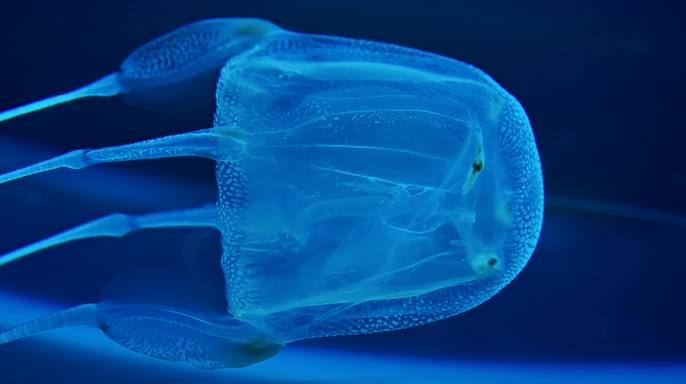
The Irukandji is a smaller Box jellyfish species. It's a small transparent cube-shaped jellyfish, measuring 2cms or less across the body.
The sting is moderately painful. Approximately 30 minutes later, someone can develop other symptoms, including - severe back and abdominal pain, limb or joint pain, nausea and vomiting, profuse sweating and agitation.
A sting from an Irukandji should be treated as a medical emergency if symptoms occur.
Non-tropical jellyfish
Found throughout Australian waters.
Bluebottle (Physalia sp.)
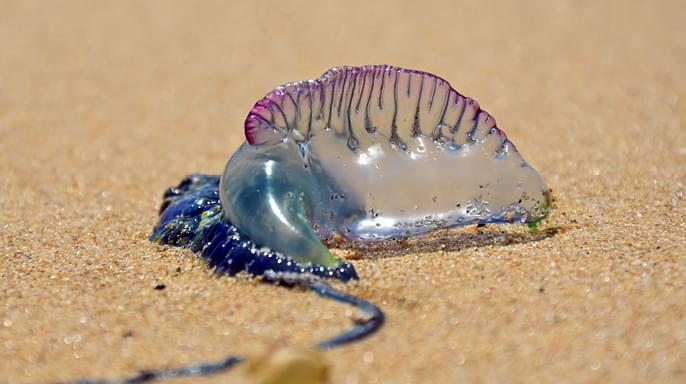
The bluebottle is well known throughout Australian waters for causing painful stings. No fatalities have been confirmed in Australia.
Their body measures 2-15 cm. The main tentacle may be up to 10m long and is responsible for most of the stings.


